

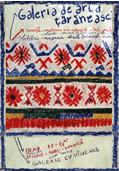
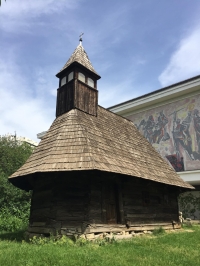
The old peasant did not surround himself with too many things, shiny and dead. His objects were few, never only decorative, impersonal or inorganic. His hands were torturing the rough material, ennobling it through suffering. The hemp spun yarn, the wood, and the wheat end in the martyr object. Stories say that any apparently humble house, any domestic object has the power to save you from death. In extraordinary conditions the lance, the hood and the pipe of the young shepherd, the foreigner, whose name the song doesn’t mention, watch the death of the master left to their holy guard. Tragic happenings awaken the energy of peasant objects. Unsuspected power is born from profane appearances. A living museum, conceived against dead things, must confess to these old meanings without words.



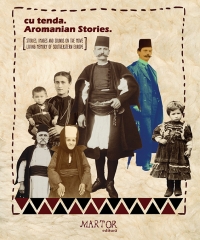


MARTOR nr. 25/2020 // MARRIAGE-MAKING AMONG ROMA IN CENTRAL AND EASTERN EUROPE: PRACTICES, IMAGINARIES, ECONOMIES
A apărut numărul 25/2020 al revistei MARTOR, cu tema „Marriage-making Among Roma in Central and Eastern Europe: Practices, Imaginaries, Economies”, volum coordonat de Ana Chirițoiu și Cătălina Tesăr. Tema numărului din acest an cuprinde 12 studii și analize (etnografice, legale, dialogice și vizuale) despre cum se încheie căsătoriile în diferite comunități rome din centrul și estul Europei. Volumul se încheie cu trei recenzii a unor titluri de referință în domeniu.
Revista se găsește online integral la adresa: http://martor.muzeultaranuluiroman.ro/
Prețul: 17,12 lei.
CUPRINS:
Ana CHIRIȚOIU, Cătălina TESĂR, Introduction: Roma Marriage-Making, Between the Constraints of “Tradition” and the “Choices” of Liberalization
I. Unpacking “Tradition”: Genealogies, Contingencies, Ideologies
Martin OLIVERA, Entre idéologie nobiliaire, utopie égalitaire et circonstances singulieres : le « bon mariage » chez les Roms Gabori
Bogdan MATEESCU, Marriage and Family Life of Romanians and Roma: Aspects Reflected in the First Two Modern Romanian Censuses
Grégoire COUSIN, « O abjáv kaj sas maškár aménde phaṟada e dušmania ». Généalogie d’un mariage
II. Marrying In, Out, and Sideways: Liberalization and Change
Andreea RACLEȘ, “Free Choice” in Marriage-Making among Romanianised Roma
Margaret BEISSINGER, “Lăutar Space”: Marriage, Weddings, and Identity among Romani Musicians in Romania
Jonathan LARCHER, Tout n’est qu’histoire d’amour. Une chronique personnelle sur les sentiments et la crainte de Dieu en « tsiganie »
Cecília KOVAI, Constraints on “Free Choice”: The Role of Marriage in a Hungarian Romungro Community
III. Law and Activism in the Case of Early Age and/or Arranged Marriages
Maria G. NIKOLOVA, Parents, Children, Marriage: Bulgarian Courts’ View on Romani Marriage-making
Angéla KÓCZÉ, Ana CHIRIȚOIU, “What’s the Point of Studying Kinship if You Don’t Connect It to the Broader Power Structure.” A Dialogue
Iulia HAȘDEU, Les femmes rom, entre statut de Romni et démocratie sexuelle. Essai d’anthropologie féministe
IV. Visual Representations of Roma Marriages
Alina ȘERBAN, Cătălina TESĂR, “We Start Our Lives from Different Positions.” A Dialogue
Ileana Gabriela SZASZ, Dare to Record! The Ethics of Decision Making in Fieldwork Documentary Practice
V. Book Reviews
Norah Benarrosh-Orsoni. 2019. La maison double. Lieux, routes et objects d’une migration rom. Nanterre : Societe d’Ethnologie, 250 p.
(recenzie de Cătălina TESĂR)
Rachel Humphris. 2019. Home-Land: Romanian Roma, Domestic Spaces and the State. Bristol: Bristol University Press, 240 p.
(recenzie de László FOSZTÓ)
Paloma Gay y Blasco, and Liria Hernandez. 2020. Writing Friendship. A Reciprocal Ethnography. Cham, Switzerland: Palgrave Macmillan, 189 p.
(recenzie de Ana CHIRIȚOIU)

Back to main page







(1).jpg)








.jpg)
.jpg)